Four Hundred and Fifty Buoyancy Modules, No Two the Same
Fugro needed the distributed buoyancy off BHP Billiton’s Stybarrow risers. The modules varied in length, diameter, uplift, orientation and inclination, some had slid down the riser until they touched, and every operation was ROV-only.
- Client
- Fugro, for BHP Billiton
- Location
- Stybarrow field, Exmouth Sub-basin, WA
- Delivery
- 6 weeks, design to delivered
- Sector
- Decommissioning
- 450 Modules to be removed
- 1.5 t Uplift of the largest module
- 6 weeks Design, manufacture, test, deliver
- ROV All operations, no divers
The problem
The Stybarrow field sits in the Exmouth Sub-basin, roughly sixty-five kilometres off Exmouth on the north-west Australian coast. Decommissioning it meant taking 450 distributed buoyancy modules off flexible risers and umbilicals. The modules differed in length, diameter, uplift, orientation and inclination, so the tooling had to absorb all of it.
Two things made it harder once work started. Some of the modules had slipped along their risers and were now sitting immediately against each other, which ruled out the simpler methods of securing a module inside a tool — there was nowhere to clamp. And the inner clamps that interface directly with the riser had to come off separately once the module was clear, and those varied in size and design too.
What we built
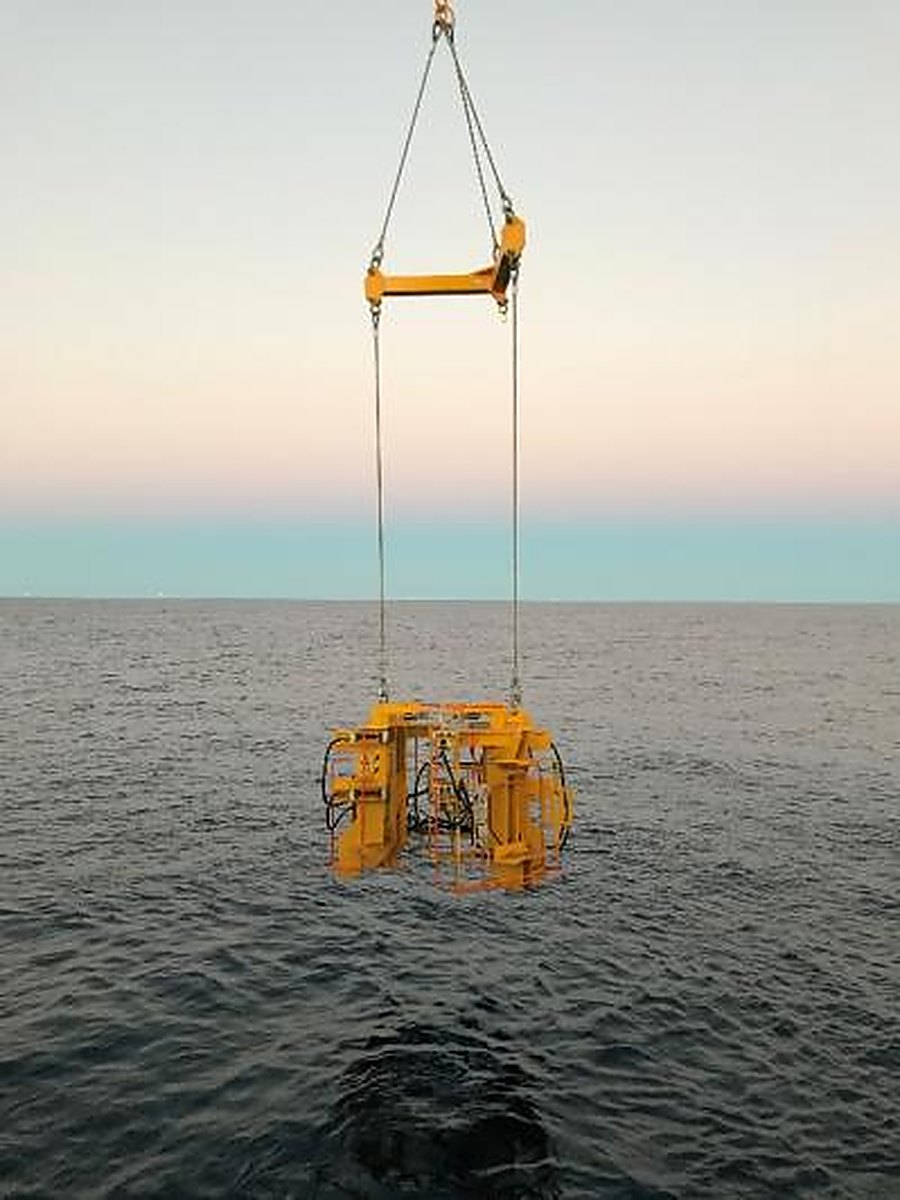
The buoyancy module removal tool is a chassis substantial enough to manage the 1.5-tonne uplift of the largest modules, closing around the module rather than gripping it from one side. A hydraulically operated ratchet mechanism rotates the module inside the tool until the split between the module halves lines up with the hinge of the chassis. Where there is space above and below, hydraulic mechanisms clamp the upper and lower faces; the securing straps are then severed, the chassis opened and the module lifted off the riser.
Where an adjacent module denied that space, an array of eight hydraulic drill pins secures the module in the tool instead, after which the sequence runs as before. Back on the vessel the pins are reversed out and the module lowered hydraulically out of the tool onto the deck. A separate tool takes the inner clamps off the riser. Bespoke lifting equipment and a subsea hydraulic chain hoist, both developed within the same scope, let the ROV adjust the attitude of the tool to match the attitude of the riser.
Six weeks
The removal tool, the internal clamp removal tool and all supporting equipment were designed, manufactured, tested and delivered inside six weeks. The tools adjust to take a wide variety of module sizes, so the same spread works on the next field.
DecommissioningHave Something With the Same Shape?
If the constraint above looks like yours, ring us and ask how it went. That is a shorter conversation than a capability statement.
Start a Conversation