Shaving the Studs Off a Flange You Must Not Mark
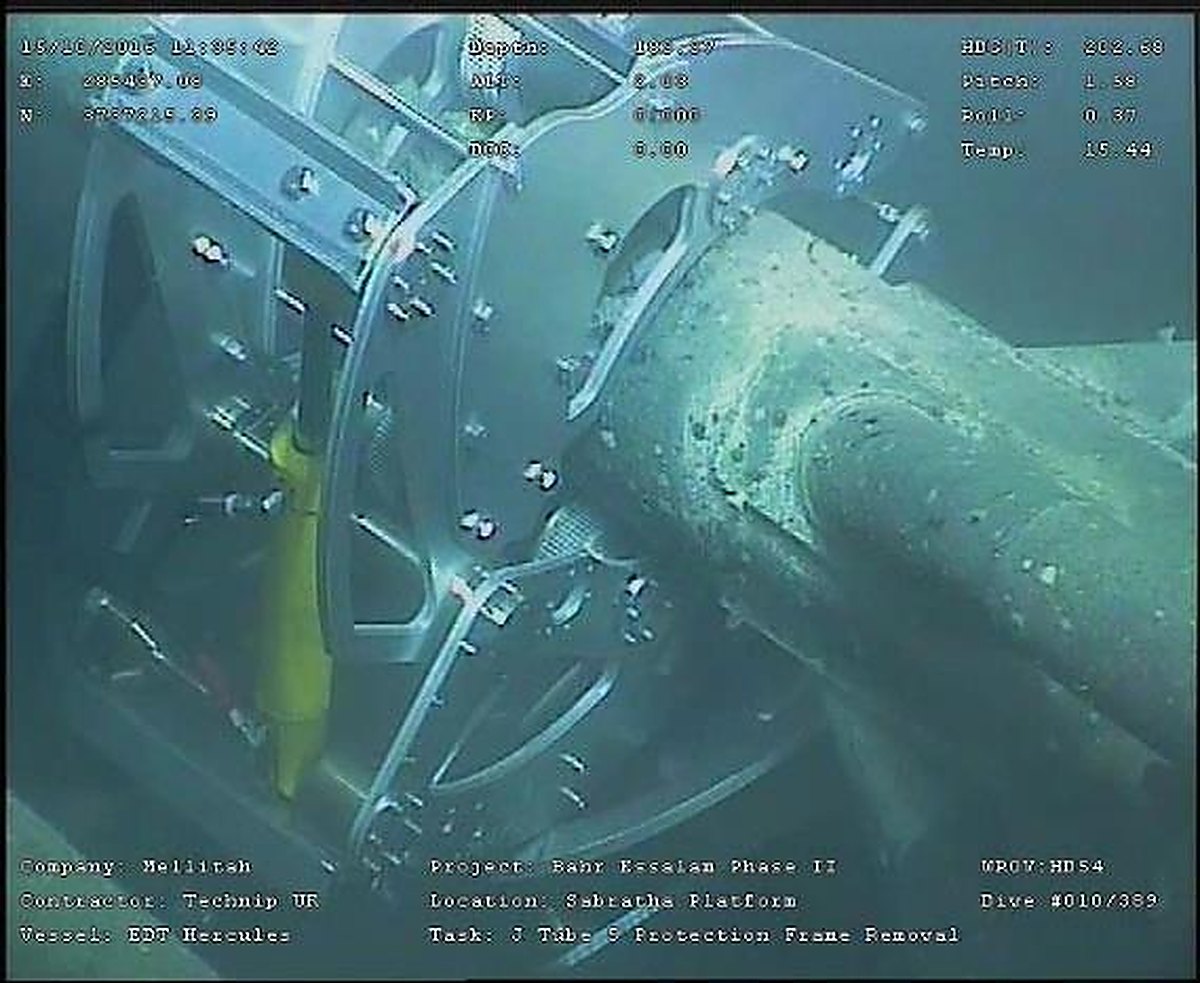
Technip UK needed blind flanges off the subsea ends of several J-tubes at Bahr Essalam, 185 metres down. Bellmouths were going onto the inboard flanges afterwards, so even superficial damage to those faces was not acceptable.
- Client
- Technip UK
- Location
- Bahr Essalam field, Mediterranean Sea
- Water depth
- 185 m
- Equipment
- FRT and 2 × PSRT
- 185 m Water depth
- 10–16 in Flange sizes accommodated
- ±12 mm Blade adjustment, by ROV
- 360° Circumferential access
The problem
Bahr Essalam is a gas and condensate field in the Mediterranean, about 110 kilometres off Tripoli. Expanding it with future tie-backs to the Sabratha platform meant removing the blind flanges from the subsea ends of several J-tubes, along with the protection structures around them, so that bellmouths could be installed on the exposed inboard flanges. The tubes came in two sizes, ten inch and sixteen inch, terminated with 300 pressure class blinds.
Two constraints shaped the tool. The J-tubes sat close enough together that a bulky solution had nowhere to go, and the inboard flanges were the sealing faces for the next campaign, so damage to them — even superficial — was not acceptable. Everything had to be installed, operated and powered from the ROV alone.
What we built
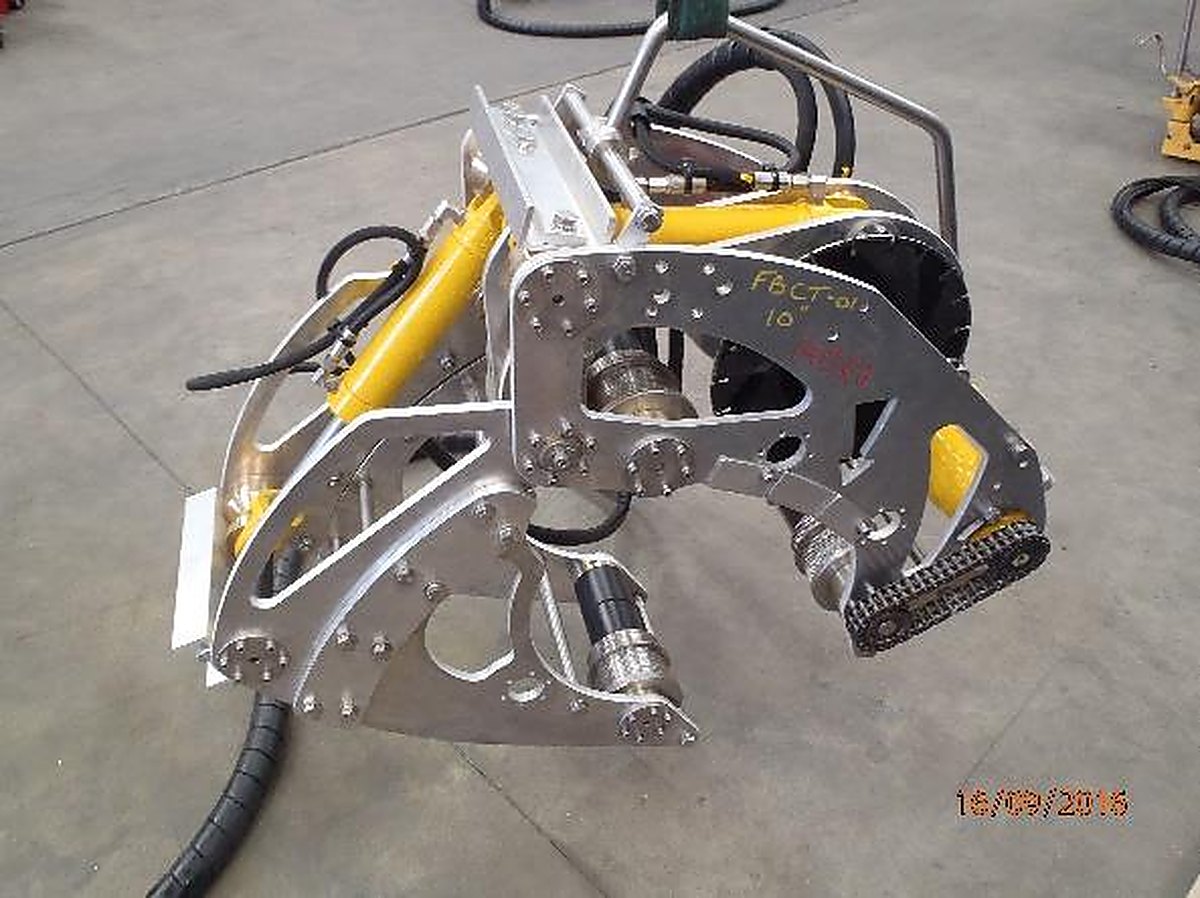
Two tool types on a common chassis: a flange removal tool to sever the studs holding the blind, and two protection structure removal tools to cut the three tubular members holding each protection structure onto the J-tube. Both close around the flange or the tube and drive circumferentially, giving 360-degree access to the cylindrical structure. Guiding features keep the tool accurately referenced off the flange and come off when the tool is working on plain pipe or tube.
This is the second generation of a tool we had built before. What was added was the interchangeability — one design taking flanges from ten to sixteen inches, or pipe — a common chassis across all the tools so spares and redundancy carry across the spread, and axial adjustment of the cutting blade position. ±12 mm of that adjustment, made by the ROV, lets the tool shave the fasteners off the face without cutting into the inboard flange. Project teams ran in Aberdeen and Perth, managed from Aberdeen.
Where else it goes
The design is not specific to blind flanges. Anything that needs a controlled circumferential cut on a cylinder suits it — grooving, severance, pipe end preparation — and the blade is interchangeable between friction and diamond, so the material range is wide.
Operations SupportHave Something With the Same Shape?
If the constraint above looks like yours, ring us and ask how it went. That is a shorter conversation than a capability statement.
Start a Conversation