Taking People Off the Highest-Risk Job on the Vessel
An operator’s cyclone disconnect procedure put people alongside an open production bore in a confined space. We replaced them with a tool, ahead of the season.
- Client
- Leading IOC (not named)
- Location
- North West Shelf, Western Australia
- Delivery
- 8 weeks
- Sector
- Subsea & Offshore
- 8 weeks Concept to delivered system
- Zero Personnel adjacent to open bore
- ~5 Cyclones in an average season
- ROV Actuated, no diver intervention
The problem
The operator’s FPSO sits off the north-west Australian coast, a region rich in oil and prolific in cyclones, averaging around five a year. Each time one comes through, the vessel disconnects from its DTM — disconnectable turret mooring. Before disconnecting completely, personnel installed Grayloc blind caps on the DTM riser flanges. The caps add a further barrier to the risers in case of a valve failure on the DTM, avoiding release of product to the environment.
The environmental logic was sound. The human exposure was not. The operator’s own assessment put the activity among the highest-risk in the business: people working directly adjacent to an open production bore, in a confined space, on a schedule set by the weather. Removing the caps afterwards carried the same exposure again, and both operations sat on the critical path for production.
What we did
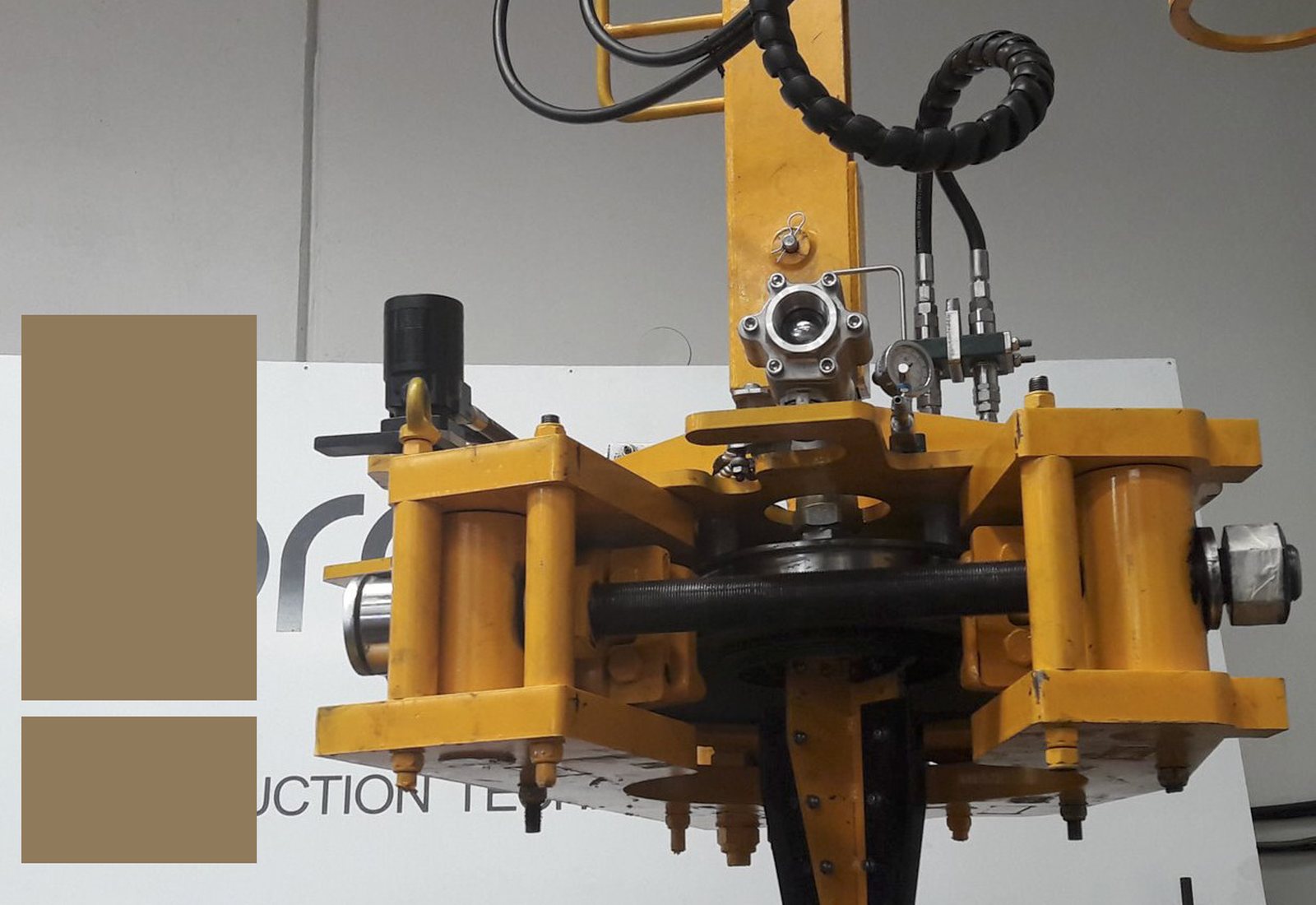
Install the blind remotely, after the DTM had been disconnected and lowered clear of the FPSO. That relieves the requirement for personnel to install the flanges topside altogether, rather than making the job safer to do.
The system uses four major components. A protective cover goes on first, shielding the sealing faces of the flange against damage while the rest of the tool is installed. A guide post and deployment arm guide the Grayloc adapter into place and lower it onto the flange in a controlled manner. Once in position, the adapter is actuated by ROV to complete the connection.
Why it was awkward
Retaining the existing Grayloc half-shells was deliberate. Replacing the whole connection would have meant requalifying it. Keeping the half-shells and substituting an alternative clamping system for the studs maintained elements of the existing design qualification and shortened the path to acceptance.
The delivery window was set by weather rather than by procurement. The solution had to be with the operator inside eight weeks to be ahead of the onset of the cyclone season. We were awarded the whole turn-key scope — design, engineering, manufacturing and testing — and the reason given was simplicity and robustness rather than sophistication.
What it delivered
- Human exposure to the task mitigated entirely.
- Manual handling drastically reduced.
- An off-line secondary barrier retained in the event of a leak or valve failure.
- Elements of the existing design qualification maintained.
- A scalable solution. Any operator running a disconnectable turret to the same procedure has the same problem.
Delivered under our former name, Proserv Australia.
Bespoke EngineeringHave Something With the Same Shape?
If the constraint above looks like yours, ring us and ask how it went. That is a shorter conversation than a capability statement.
Start a Conversation